Kundan Chandelier Earrings – Pink Beads
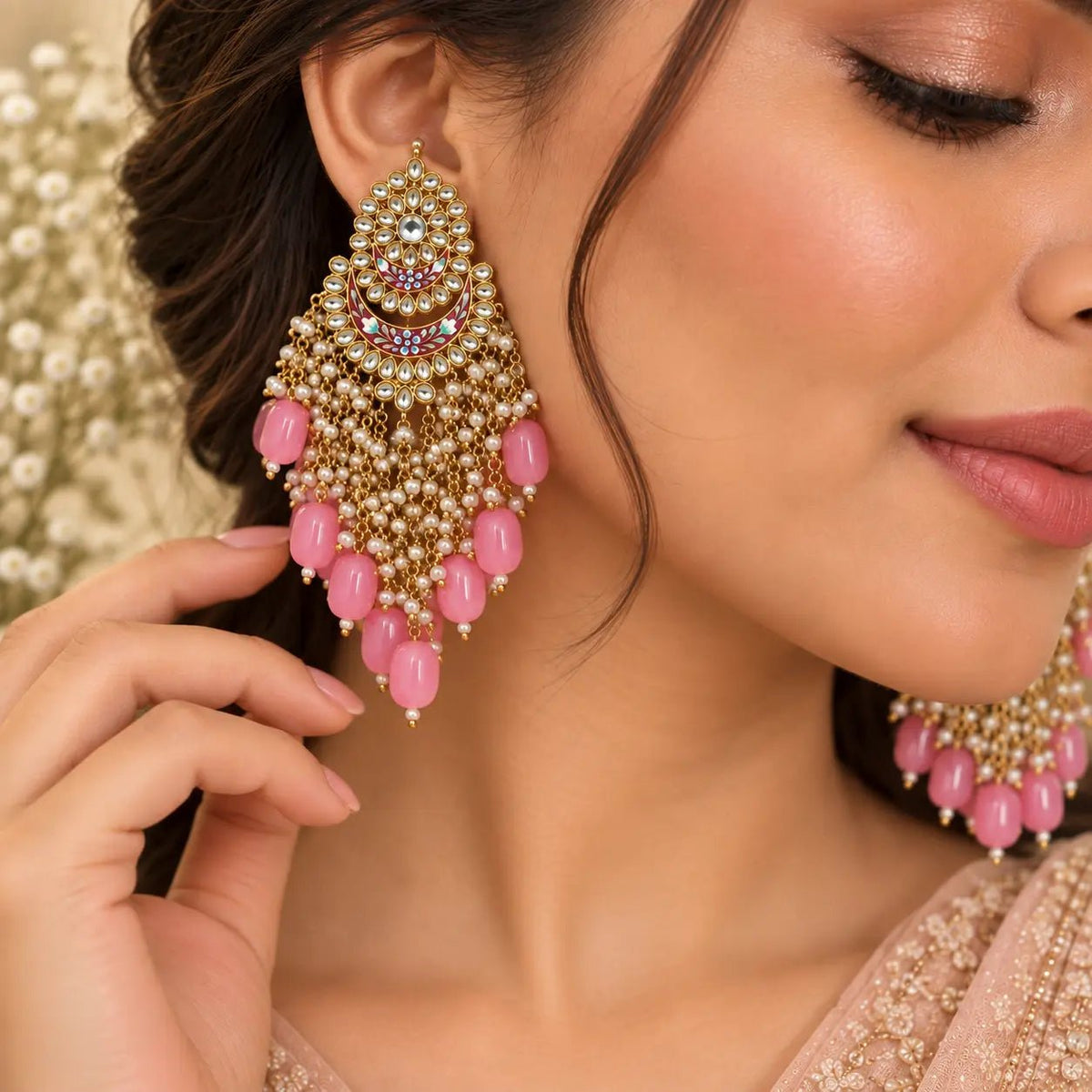
Chandelier earrings live or die on one thing — how well they hold their shape once all that fringe starts moving. A lot of them look incredible sitting still in a product photo and then collapse into a mess of beads the second you turn your head. These don't have that problem. Every layer is built to hang from a clear structure above it, so even with this much going on — kundan, meenakari, pearls, and pink beads all stacked into one earring — it still reads as one shape instead of a pile of decoration.
The Design, Looked at Closely
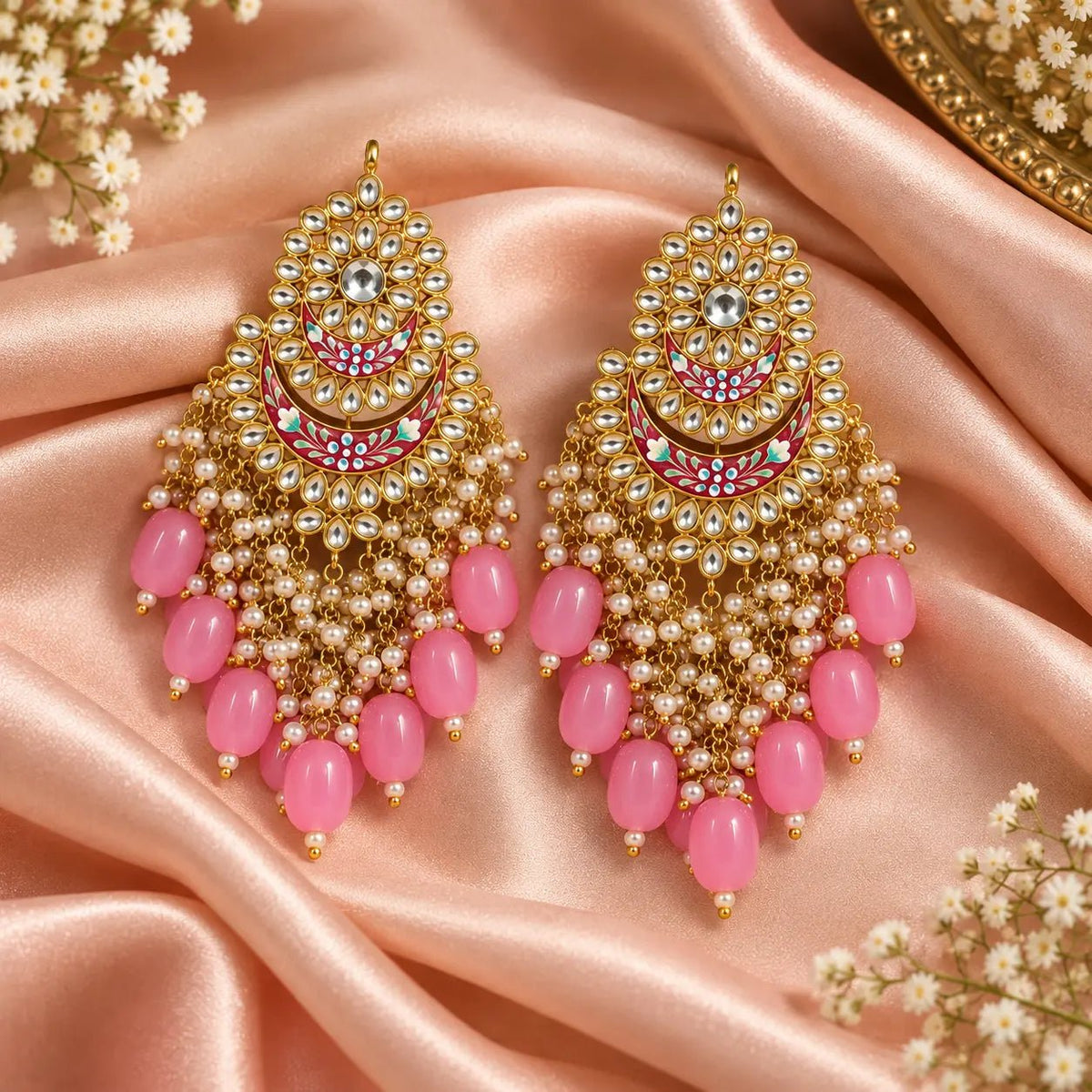
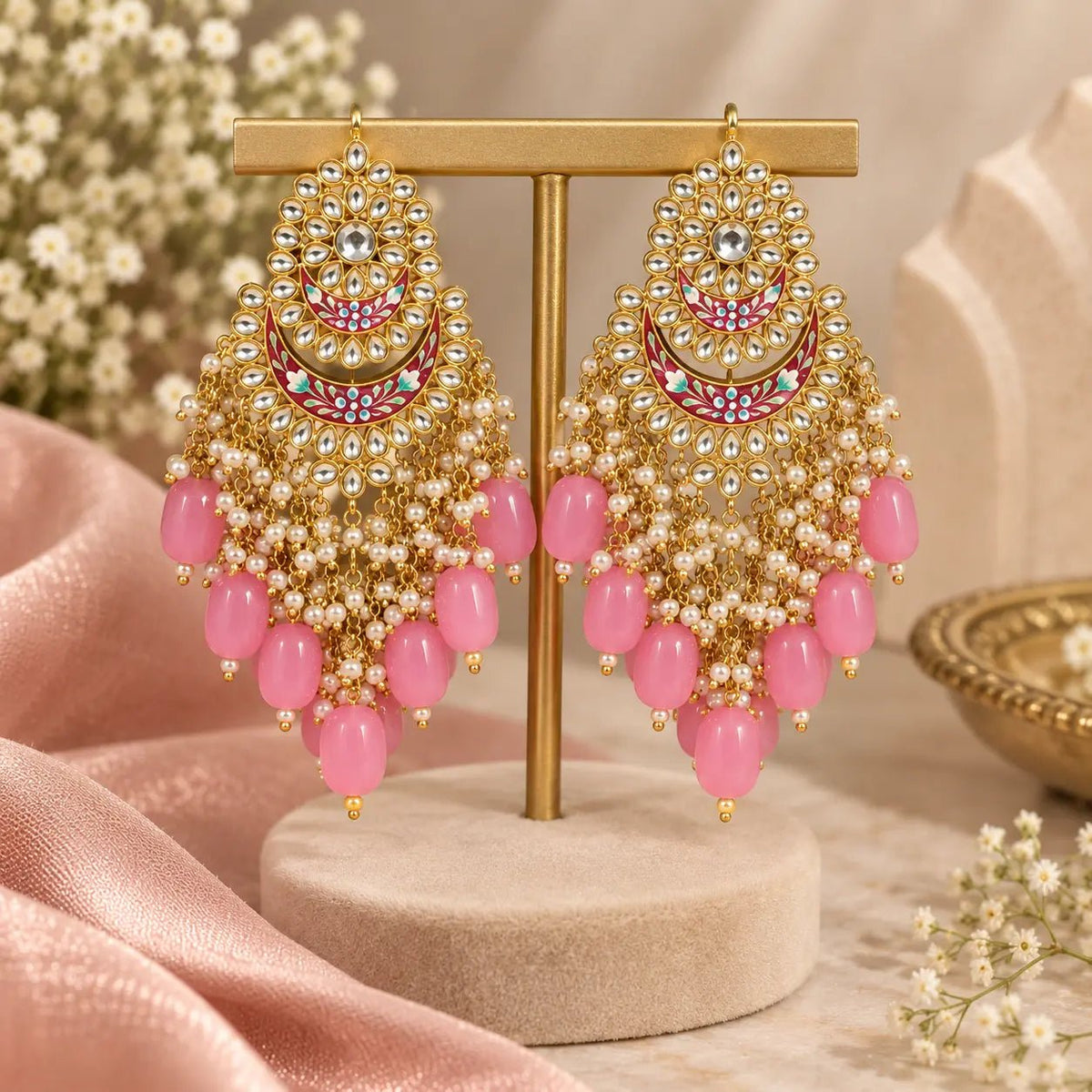
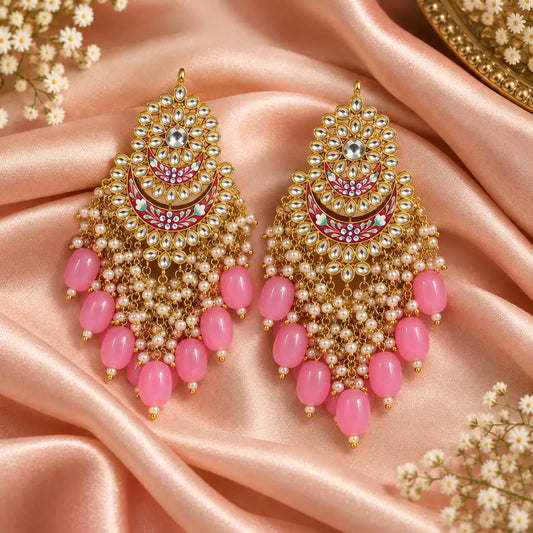
Start at the top, because everything below is hanging off this one anchor point. Each earring opens with a large teardrop-shaped kundan cluster — rows of flat, faceted kundan stones set edge to edge in gold, with a single larger stone sitting at the centre like the whole piece is pinned there. That's the part doing the quiet, structural work. It's dense, it's bright, and it gives the earring a solid visual base before anything else even starts.
Right below that sits a crescent, moon-shaped section, and this is where the design shifts character completely. Instead of more kundan, it's finished in meenakari — hand-painted enamel work in deep maroon and pink, with small floral details picked out across the surface. That crescent is bordered in its own ring of kundan stones, so it doesn't feel disconnected from the section above it, but the painted colour inside the crescent is what actually breaks up all that white-gold sparkle and gives the earring some warmth and personality instead of just being "shiny."
From the base of the crescent, everything opens into the fringe, and this is genuinely where most of the earring's character comes from. Dozens of tiny pearl-toned beads hang in loose clusters across the whole width of the piece, strung individually rather than as one solid curtain, so they move independently and catch light at different moments rather than all at once. Woven through that pearl fringe, larger oval beads in a soft rosy pink hang lower and heavier, pulling the eye downward and giving the fringe actual weight at the bottom rather than just fading out into nothing. The pink beads aren't evenly spaced either — they cluster more toward the centre and thin out toward the edges, which is what keeps the fringe looking organic rather than manufactured in a perfectly even row.
Put together, the earring moves through three completely different textures on the way down — the tight, structured kundan at the top, the smooth painted colour of the meenakari crescent in the middle, and the loose, swinging beadwork at the bottom. That's a lot of different techniques to balance in one earring, and it's exactly why these read as "chandelier" pieces in the proper sense rather than just a big earring with some beads glued underneath.
Specifications
| Detail | Specification |
|---|---|
| Product Type | Chandelier earrings |
| Style | Kundan and meenakari with pearl and pink bead fringe |
| Base Metal | [confirm — gold-plated alloy or brass base] |
| Stonework | Kundan (flat-cut glass stones), bezel-set throughout the top and crescent sections |
| Enamel Detail | Meenakari hand-painted crescent, maroon and pink floral motifs |
| Fringe | Clustered pearl-toned beads with larger rosy-pink oval bead drops |
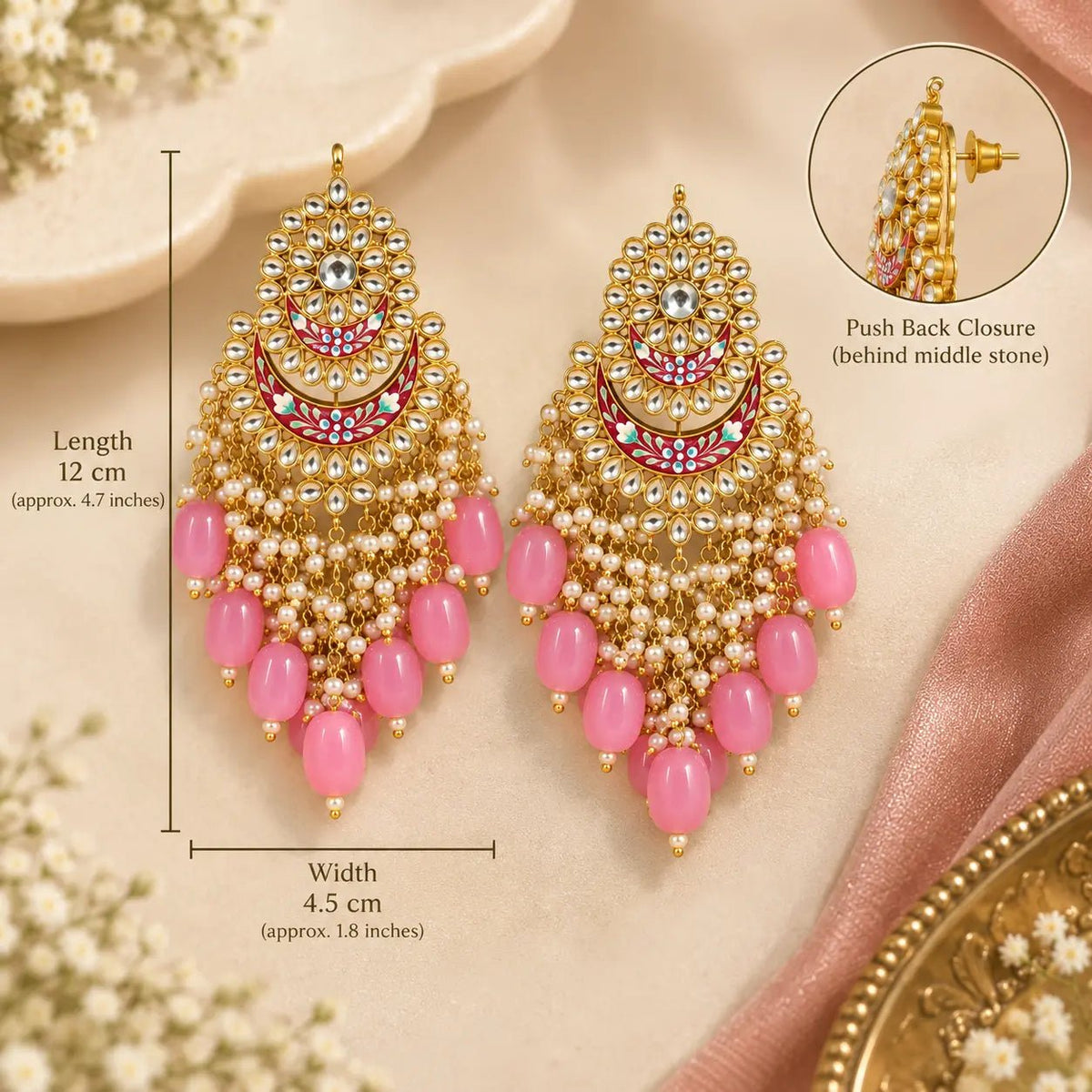
| Back Type | [confirm — hook or push-back] |
| Length | 12 cm (approx. 4.7 inches) |
| Width | 4.5 cm (approx. 1.8 inches) |
| Included Pieces | 1 pair of earrings |
| Ideal Occasion | Weddings, festive functions, mehendi and sangeet, traditional wear |
| Care | Keep away from perfume, water, and direct sunlight; store flat, separately from other jewellery |
Why the Layered Construction Matters
It would've been much simpler to build these as one dense kundan cluster with a plain bead tassel hanging off the bottom — plenty of chandelier earrings are exactly that. What actually separates a well-made pair from a basic one is whether each section is doing something different, and here it clearly is. The kundan top is structural. The meenakari crescent is where the colour lives. The fringe is where the movement happens. Strip out any one of those three and the earring loses something specific — take away the meenakari and it's just kundan and beads with nothing warming it up; take away the fringe and it's a static, flat pendant with no life to it once it's actually on.
Why the Meenakari Crescent Is the Key Detail
Kundan on its own, especially in a large cluster like the top of this earring, throws a lot of white-gold sparkle and not much else. The meenakari crescent underneath breaks that pattern deliberately. Painted enamel work brings in actual colour and a hand-finished quality that stonework alone can't replicate, and placing it directly below the kundan cluster means your eye moves from "sparkle" to "colour" as it travels down the earring, rather than getting the same visual note repeated the whole way through.
Why the Fringe Reads as Fuller Than It Should
A lot of bead fringe on earrings this size ends up looking thin or wiry once it's actually hanging, because the beads are strung too uniformly and too sparsely. This one avoids that by clustering the pearl beads densely and letting the larger pink beads sit unevenly through them rather than in a neat repeating pattern. That irregularity is what makes the fringe look intentional and full rather than sparse — it's mimicking how fringe actually falls naturally, instead of forcing a rigid, symmetrical repeat.
Who This Pair Actually Suits
These are festive and bridal-adjacent earrings, built for the kind of occasion where a bit of movement and colour at the ear is expected — weddings, sangeets, mehendi functions, and festive family events. The maroon-and-pink meenakari pairs especially well with peach, blush, ivory, or deep jewel-toned outfits, where the painted crescent has something rich to sit against rather than getting lost.
Styling It
Given how much is already happening across the length of these earrings, keep the neck relatively simple — a plain chain or no necklace at all lets the earrings stay the clear focal point instead of competing with something equally detailed. Pull hair back or to one side so the full length of the fringe is visible; most of what makes these interesting happens in that lower half, and it's easy to lose if hair is covering it.
Taking Care of Them
The kundan settings and the painted meenakari surface both need a bit more care than plain metal jewellery, since stone settings collect residue easily and enamel work can dull or chip if it's knocked around. Keep the earrings away from direct contact with perfume, lotion, and water where you can, and store them flat, ideally in a lined box or pouch, so the fringe doesn't tangle or the meenakari crescent doesn't scrape against harder jewellery. A soft, dry cloth is usually enough to keep the surface looking clean between wears.
Why This Pair's Worth Considering
Plenty of chandelier earrings lean on one technique and call it done — all kundan, or all beadwork, with nothing else going on. This pair actually stacks three distinct techniques into one earring, each doing a different job, which is what gives it real depth instead of just size. If you want earrings that hold their shape and their detail even once the fringe starts moving, this is built with exactly that in mind.